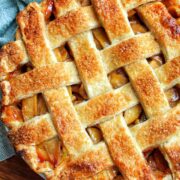
3 Ingredient Pie Crust By Hand
With only 3 main ingredients, finally master a super flaky and flavorful all-butter pie crust by hand. This crust can be used for all your favorite holiday pies, including hand pies, galettes, or tarts.
Servings: 2 (9 inch or 23 cm) pie crusts
Calories: 397kcal
Equipment
- bench scraper
- Rolling Pin
- 9 inch (23 cm) aluminum metal pie plate
- kitchen scissors or a sharp paring knife
- fork
- pie weights (or dried beans/rice)
Ingredients
- 3 ¼ cups all purpose flour
- ½ teaspoon fine sea salt
- 1 cup (2 sticks) cold unsalted butter cut into ½ inch (1 cm) pieces
- ½ cup cold water plus more as needed (add a few ice cubes to keep the water cold)
Instructions
- Add flour and salt to a large mixing bowl and whisk to combine. Add cold, cubed butter and toss to coat each piece in flour.
- Using clean hands, work the butter and flour together by flattening the butter with your fingers. Once all the butter is flattened, ensure all pieces are coated in flour.
- Add ½ cup (114 grams) of water (no ice) to the flour and butter mixture and toss to combine. Push the dough together to check the hydration level. The dough should easily hold together, but not feel too wet or sticky. You'll need to add more water if the dough isn't holding together or you notice dry patches of flour. Add an additional 1 tablespoon (14 grams) of water at a time until no dry spots remain.
- Pour the dough onto a clean work surface. Pat any excess flour into the dough, then shape into a rectangle and tightly wrap with plastic wrap. Rest in the refrigerator for 30 minutes - 1 hour, until the dough has fully chilled.
- Lightly flour a clean work surface. Roll the dough out into a large rectangle, about ¼ inch (6 mm) thick. Fold the dough in thirds, bringing the right side of the dough to the middle then overlapping the left side of the dough on top. Cut the dough in half with a bench scraper or knife (so you have two smaller rectangles) and stack them on top of each other. Repeat this process one additional time, at which point the butter should be evenly laminated within the pie dough (no large chunks remaining). If at any point during this process you notice the crust sticking to the counter or the rolling pin, add a light dusting of flour. Cut the dough in half and shape each piece into a circle and tightly wrap with plastic wrap. Rest in the refrigerator for at least 1 hour or overnight, until the butter has fully solidified and chilled.
- Lightly flour a clean work surface. Grab one piece of dough at a time and roll into a circle that's slightly larger than a 9 inch (23 cm) aluminum metal pie plate and ¼ inch (6mm) - ⅛ inch (3mm) thick. Place the dough inside the pie plate. Use kitchen scissors or a sharp paring knife to trim any excess dough, leaving a ½ inch (1- 2 cm) of overhang. Tuck the end of the pie crust underneath itself and press together to make a uniform crust that's flush with the edge of pie plate. Lightly cover with plastic wrap and rest in the refrigerator for 30 - 45 minutes until the dough has fully chilled.
- To Par-Bake (Often used for single crust pies, custard fillings, quiche, etc.): Heat oven to 425°F (220°C). Dock the bottom of the pie crust with a fork to add holes for steam to vent. Line the chilled pie crust with parchment paper and fill to the rim with pie weights (or dried beans/rice). Bake for 17 - 20 minutes, until the edges are lightly browned. Remove the pie weights and parchment paper. Return to the oven to cook for an additional 2 - 4 minutes, until the bottom of the crust looks less wet.
- To Blind Bake (Often used with cream or cold pies when filling doesn't need to be baked): Heat oven to 425°F (220°C). Dock the bottom of the pie crust with a fork to add holes for steam to vent. Line the chilled pie crust with parchment paper and fill to the rim with pie weights (or dried beans/rice). Bake for 17 - 20 minutes, until the edges are lightly browned. Remove the pie weights and parchment paper. Return to the oven to cook for an additional 7 - 12 minutes, until the bottom of the crust is golden brown.
- For Double Crust Pies: Bake according to the recipe's instructions.
Notes
Pie Dough Storage: You can place the pie dough tightly wrapped in plastic wrap in the refrigerator for up to 3 days. For freezer storage, tightly wrap in plastic wrap, then place in a freezer-friendly Ziploc bag. It will last in the freezer for up to 3 months. Place in the fridge overnight to thaw before rolling out.
It's important to keep your ingredients and pie dough cold throughout the process. This is because the butter needs to be super cold so it can melt in the oven and create steam. This is what yields a flaky pie dough.
Don't over-knead the pie dough when you're mixing the water with the flour and butter. This can result in a tough crust. I like to push the dough together (rather than knead it). This will help hydrate the flour without kneading and forming extra gluten.
Nutrition
Serving: 1serving (⅛ of double crust) | Calories: 397kcal | Carbohydrates: 39g | Protein: 5g | Fat: 24g | Saturated Fat: 15g | Polyunsaturated Fat: 1g | Monounsaturated Fat: 6g | Trans Fat: 1g | Cholesterol: 64mg | Sodium: 150mg | Potassium: 61mg | Fiber: 1g | Sugar: 0.2g | Vitamin A: 739IU | Calcium: 15mg | Iron: 2mg
