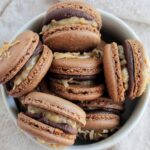
German Chocolate Cake Macarons
These chocolate French macarons are filled with rich chocolate ganache and a pecan and coconut center inspired by German cake. Bake some coconut on top of the macarons for a simple but elegant garnish.
Servings: 30 macarons
Calories: 137kcal
Equipment
- stand mixer with whisk attachment
- light colored baking sheets
- silicone mat or parchment paper
- pastry bag with ½ inch (1.3 cm) round tip
Ingredients
Chocolate Macaron Shells
- 112 grams egg whites
- 140 grams super fine almond flour
- 140 grams confectioners' sugar
- 20 grams natural unsweetened cocoa powder
- ½ teaspoon cream of tartar
- 126 grams granulated sugar
- ¼ cup shredded sweetened coconut flakes for garnish (optional)
Chocolate Ganache
- ½ cup semi-sweet chocolate morsels
- 6 tablespoons heavy cream
- 2 tablespoons unsalted butter softened to room temperature and cut into 1 tablespoon (14 grams) pieces
- 1 teaspoon vanilla extract
- ⅛ teaspoon fine sea salt
German Chocolate Filling
- ¼ cup evaporated milk
- ¼ cup firmly packed light brown sugar
- ¼ cup unsalted butter
- 1 large egg yolk
- ¼ cup shredded sweetened coconut flakes
- ¼ cup toasted pecans roughly chopped
- 1 teaspoon vanilla extract
Instructions
For Chocolate Macaron Shells
- Separate egg whites from yolks, and allow egg whites to come to room temperature.
- Measure dry ingredients using a kitchen scale. Double-sift the almond flour, confectioners' sugar, and cocoa powder together in a large mixing bowl.
- Wipe down the mixing bowl and whisk attachment with a little white vinegar on a paper towel to remove any leftover oils.
- Print off the macaron template. Place them on a light colored sheet pan underneath a piece of parchment paper.
- Prepare your piping bag with a ½ inch (1.3 cm) round tip. Push part of the side of the piping bag into the piping tip to ensure nothing leaks out. Set the bag inside a tall glass, and pull the remaining top of the piping bag out over the outside of the glass to make pouring the batter easy and clean.
- Add room temperature egg whites and cream of tartar to a stand mixer bowl fitted with a whisk attachment. Whip on medium-low speed until the eggs are very foamy, about 3 minutes. Add a third of the granulated sugar at a time, allowing the mixer to beat in each batch of sugar for about 45 seconds before adding in another batch.
- Once all the granulated sugar is incorporated, turn the mixer speed to medium-high, and allow the egg whites to continue to whip until stiff peaks form, about 10–11 minutes. Once at stiff peaks, you'll notice the meringue starts to ball up inside the whisk and is glossy. To test the meringue stiffness, pull the whisk out. A stiff peak should stand straight up (no curl at the tip). You'll also know it's ready because you can fully flip the bowl over and nothing moves or falls out. Make sure not to overbeat the meringue at this stage (this is when the egg whites look dull or curdled).
- Pour the sifted almond flour, confectioners' sugar, and cocoa powder into the meringue mixture, and gently fold them together using a silicone spatula. Continue until all the meringue is fully incorporated and no dry bits of almond flour remain on the bottom of the bowl.
- Begin working the batter until everything is fully incorporated (this is called the macaronage process). Slowly, spread the mixture along the side of the bowl, then wipe it back down. Be sure to do this gently. Repeat until the mixture has reached a smooth, shiny, flowing consistency. You can test this by lifting your spatula and seeing if the batter drops almost like lava. Once the batter drops back into the bowl, it should take about 10–15 seconds for the ribbon that formed to "disappear" back into the rest of the batter. Don't over macaronage the batter or the macarons will not properly bake in the oven.
- Pour the batter into the prepared piping bag. Hold the bag vertically, and pipe 1.5 inch (3.8 cm) circles. Once you have reached the desired size, release the pressure on the bag, and twist your wrist without lifting up. Continue until no batter remains.
- Bang the sheet pan down on the counter a few times to release any air bubbles. Pop the air bubbles with a toothpick. Optionally, top half of the macaron shells with coconut flakes while the batter is still wet. Allow the batter to sit on the counter and dry for 60+ minutes until a thin "skin" develops, and you can touch the tops without ruining the macaron. This resting time will vary depending on the humidity (they may take up to 90+ minutes to dry if you live in a humid or rainy environment). While the macarons are drying, place the oven thermometer in the center rack of the oven. Heat oven to 300°F (150°C).
- Bake one sheet at a time on the center rack of the oven for 24–27 minutes. You can test that the macarons are done by gently touching the edge and the feet of the macarons. If the shell wiggles, is sticky, or wet, the macarons need to bake longer. Remove macarons from the oven, and allow the pan to rest on a wire cooling rack until completely cooled.
For Chocolate Ganache
- Place chocolate morsels and butter in a medium-sized heat-safe bowl.
- Heat heavy cream in the microwave on 100 percent power (high) for 45–60 seconds until the heavy cream begins to steam (but doesn’t boil over). Immediately, pour the heavy cream over the chocolate. Make sure all of the chocolate is submerged under the cream. Allow the mixture to sit, without stirring, for 3 minutes.
- Add vanilla extract and fine sea salt to the chocolate. Stir until the mixture is smooth and fully blended. If there are still bits of chocolate or butter after stirring for 60–90 seconds, heat the mixture in the microwave on 50 percent power (medium) for an additional 15–30 seconds, then stir until the correct consistency forms.
- Transfer ganache to a shallow container, and press plastic wrap against the surface of the ganache (to prevent a skin from forming on top). Place the ganache in the fridge, and allow the mixture to cool until it’s firm enough to pipe, about 1–2 hours.
For German Chocolate Filling
- Cook evaporated milk, brown sugar, butter, and egg yolk in a small saucepan over medium high heat until bubbling. Whisk constantly until the mixture begins to thicken, about 1–2 minutes.
- Remove from the heat, and stir in coconut flakes, pecans, and vanilla extract. Place in the fridge, and allow the mixture to cool until it’s firm enough to pipe, about 1 hour.
- Match up macaron shells so that a coconut top is paired with a similar size/shaped plain shell. Pipe the chocolate ganache filling along the outer edge of one side of the macaron shell using a ½ inch (1.3 cm) round piping tip. Spoon the german chocolate cake filling on the inside of the chocolate ganache. Gently, place the matching shell on top of the filling.
- Mature the macarons with the filling in an airtight container in the refrigerator overnight. This will allow the macarons to slightly soften and develop a deeper flavor.
- Store the macarons in an airtight container in the refrigerator for up to 3–5 days. To serve, allow the macarons to come to room temperature.
Notes
Having trouble with your macarons? See the full troubleshooting guide above.
Whipping the meringue to stiff peaks (not over or under) is one of the most crucial steps when making macarons. Both under-whipped and over-whipped meringue can result in cracked shells. This is because the meringue needs to have the proper structure in order to rise in the oven.
In order to achieve stiff peaks, you need to learn the visual cues you can use to know that your meringue has whipped to stiff peaks:
- You'll notice the meringue starts to ball up inside the whisk while it's mixing.
- Pull the whisk out of the mixer. A stiff peak should stand straight up (no curl at the tip).
- You can fully flip the bowl over and nothing moves or falls out.
- The meringue feels sturdy (not flimsy).
Nutrition
Serving: 1macaron | Calories: 137kcal | Carbohydrates: 15g | Protein: 2g | Fat: 8g | Saturated Fat: 4g | Polyunsaturated Fat: 0.4g | Monounsaturated Fat: 2g | Trans Fat: 0.1g | Cholesterol: 16mg | Sodium: 25mg | Potassium: 63mg | Fiber: 1g | Sugar: 13g | Vitamin A: 130IU | Vitamin C: 0.1mg | Calcium: 24mg | Iron: 1mg
