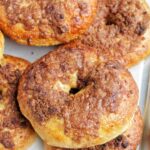
Cinnamon Sugar Bagels
If you're looking for a sweet and indulgent bagel, try these cinnamon and sugar bagels. They're topped with a crunchy, brown sugar crumble.
Servings: 12 bagels
Calories: 361kcal
Equipment
- kitchen scale
- bench scraper or knife
- pizza stone
- large pot or dutch oven
- slotted spoon or spider strainer
- wire rack
Ingredients
Bagel Dough
- 2 cups plus 2 tablespoons lukewarm water (110°F or 43°C)
- 1 tablespoon plus several tablespoons for boiling molasses
- 2 teaspoons active dry yeast
- 7 cups bread flour
- 2 teaspoons Morton kosher salt
- cornmeal for dusting
Cinnamon Sugar Topping
- ½ cup firmly packed dark brown sugar
- 6 tablespoons bread flour
- 3 tablespoons granulated sugar
- 3 tablespoons unsalted butter melted
- 3 teaspoons ground cinnamon
- 1 large egg
Instructions
For Bagel Dough
- Add warm water, 1 tablespoon (17 grams) molasses, and yeast to a small bowl and whisk together until dissolved. Allow the mixture to sit until it’s foamy on top, about 5 minutes.
- Whisk together flour and salt in a stand mixer bowl. Fit stand mixer with the dough hook attachment (see notes below for hand kneading instructions). Combine the water and yeast mixture with the flour on low speed, just until a shaggy dough forms. Scrape down the sides and increase speed to medium as needed, until the majority of the loose flour is incorporated into the dough. Once a shaggy dough is formed, increase the speed to medium high, and set a timer for 10 minutes to allow the dough to knead. During this time, keep an eye on your stand mixer to ensure it doesn’t wiggle off the counter or overheat. If at any point your mixer becomes too hot, take a break or begin hand kneading (see notes). The dough is done kneading when it is flexible and bouncy to the touch. To check that the dough is ready, grab a piece of dough between your fingers, stretch it, and see if web fibers have developed. You should be able to pull the dough thin enough that light shines through. If your dough rips as soon as you start pulling, you need to continue kneading the dough. You want the dough to be able to stretch rather than tear.
- Roll the dough into a tight ball, then place it in a clean bowl, and cover with plastic wrap. Allow the dough to rise in a warm, draft-free place until doubled in size, about 60–90 minutes. Rise time will vary depending on the temperature of your environment.
- While the dough is rising, prepare two baking sheets generously sprinkled with cornmeal. Set aside.
- Punch down the risen dough a few times to release some of the gas that formed. On a clean, un-floured surface, remove the dough from the bowl. Using a bench scraper or knife, divide the dough into pieces weighing 4 ounces (113 grams).
- Working with one piece of dough at a time, and keeping the others covered with a tea towel, roll the dough into a ball. Push through the center of the ball using both thumbs to make a hole. Then, continue to stretch the bagel out until it reaches about 4 inches (10 cm) across. Be sure not to flatten the bagel too much throughout this process. Place completed bagels about 2 inches (5 cm) apart on the previously prepared baking sheets, and cover with plastic wrap. Repeat until all pieces of the dough have been shaped.
- Securely cover the bagels with plastic wrap, so no air can get into the baking sheet. Allow dough to proof overnight in the refrigerator for 12–18 hours.
For Cinnamon Sugar Topping
- Arrange the oven racks to the upper and lower thirds of the oven. Place a pizza stone on each of the racks, then heat oven to 450°F (230°C). Allow the oven and pizza stones to preheat for at least 30 minutes.
- Whisk dark brown sugar, bread flour, melted butter, granulated sugar, and cinnamon in a small mixing bowl until combined. In a separate bowl, whisk egg and 1 tablespoon (14 grams) of water to make an egg wash.
- Fill a large pot or dutch oven about halfway full with water. Place over high heat to boil. Once the water is at a rolling boil, add in molasses, a tablespoon at a time, until the water is dark brown.
- Remove the bagels from the refrigerator. They will have puffed up slightly overnight. Gently, place as many bagels into the boiling water as will comfortably fit without over crowding the pot or dutch oven. Allow the bagels to boil for 30 seconds on the first side, then flip and boil for an additional 30 seconds on the second side. Using a slotted spoon, remove the bagel from the boiling water and place on a wire rack to cool. Immediately brush the bagel with egg wash and top with cinnamon sugar mixture (about 1 tablespoon or 15 ml). Repeat until all of the bagels have been boiled and topped with cinnamon sugar.
- Carefully, remove the hot pizza stones from the oven. Transfer the cornmeal from the original baking sheets to the hot pizza stone to prevent sticking. Place bagels on the stone about 2 inches (5 cm) apart. Bake for 15–19 minutes, rotating the pans halfway through baking, until bagels are golden brown and shiny on top. Keep an eye on your bagels (without opening the oven door) to ensure they're not getting too dark. Remove from the oven and let cool completely on a wire rack.
Video
Notes
STORAGE: Bagels can be stored for up to 4 days in an airtight container at room temperature. I suggest toasting to reheat. Bagels can also be frozen for up to 6 months. I suggest slicing them in half before you freeze them in an airtight container or bag. Then, you can pop the frozen bagel straight into the toaster. Learn more about my best bagel storage tips.
HAND KNEADING: Whisk together flour and salt. Slowly, add in the water and yeast mixture and mix with a wooden spoon or clean hands until a shaggy dough forms.
Then, begin kneading the dough by hand for a full 15 minutes (don’t cut this time short). If needed, switch out kneading the dough with a friend! If the dough is sticking to the counter, add more flour, a tablespoon at a time, to prevent this.
The dough is done kneading when it is flexible and bouncy to the touch. To check that the dough is ready, grab a piece of dough between your fingers, stretch it, and see if web fibers have developed. You should be able to pull the dough thin enough that light shines through. If your dough rips as soon as you start pulling, you need to continue kneading the dough. You want the dough to be able to stretch rather than tear.
Instant Yeast: You can substitute active dry yeast for instant yeast. Use the same amount as is listed in the recipe.
Don't have a pizza stone? You can use a light-colored sheet pan instead.
Need help troubleshooting what went wrong with your bagels? See the full troubleshooting guide above!
Nutrition
Serving: 1bagel | Calories: 361kcal | Carbohydrates: 69g | Protein: 10g | Fat: 5g | Saturated Fat: 2g | Polyunsaturated Fat: 1g | Monounsaturated Fat: 1g | Trans Fat: 0.1g | Cholesterol: 23mg | Sodium: 401mg | Potassium: 127mg | Fiber: 2g | Sugar: 13g | Vitamin A: 113IU | Vitamin C: 0.02mg | Calcium: 32mg | Iron: 1mg
